Hamilton Townhouses: Condo, Freehold or POTL?
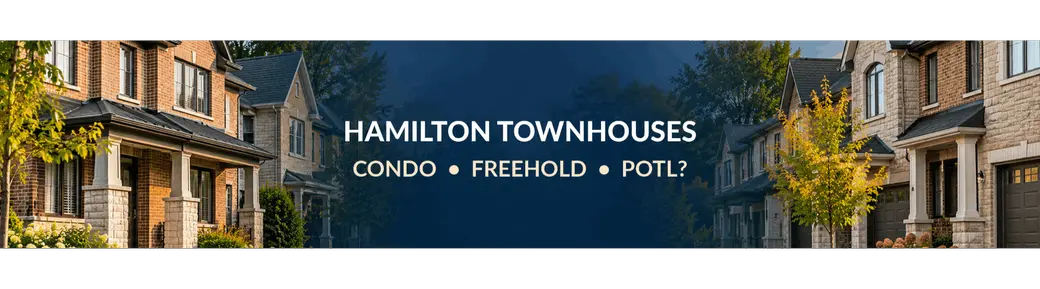
Hamilton and Ancaster | Townhouse buyer guidance
Condo, freehold or POTL? Know what you're buying.
The ownership structure changes what you pay, what you maintain and which documents you need to review before buying a townhouse.
When you're looking at townhouses in Hamilton or Ancaster, the listing may describe a property as freehold, condominium or POTL. The buildings can look very similar, but those words affect your legal ownership and the costs that come with it.
Before deciding that one townhouse is the better value, find out who owns the land and shared areas, who pays for repairs, whether there are monthly common expenses and which restrictions apply. The listing is a starting point. Your lawyer needs to confirm the actual title and registered documents.
The main distinction: A typical freehold townhouse includes ownership of the home and its lot. A condominium townhouse is a unit within a condominium corporation. A POTL is a separately owned parcel of land with a legally attached interest in a common-elements condominium. POTL ownership can include mandatory shared expenses even though the house is freehold.
What each ownership type means
You own the house and lot
With a conventional freehold townhouse, you generally own your individual parcel and are responsible for maintaining the home and land. You arrange appropriate insurance and pay the normal property costs.
There is generally no condominium corporation collecting common expenses. However, shared walls, private services, access rights or maintenance agreements can still create obligations that need to be checked on title.
You own a condo unit
You own a condominium unit and an interest in the corporation's common elements. You pay common expenses that support the corporation's obligations and reserve fund.
Exactly what belongs to the unit, which exterior elements the corporation maintains and what you may change depends on the declaration, condominium plan, by-laws, rules and applicable law. The fact that it looks like a house does not settle those questions.
You own freehold land plus a tied condo interest
POTL means Parcel of Tied Land. You own a separate freehold parcel, but an interest in a common-elements condominium is legally attached to it.
The condominium corporation may manage shared roads, visitor parking or other common infrastructure. You may still be responsible for the house and yard while paying mandatory shared expenses. The documents determine the division.
Ontario's Condominium Authority of Ontario buyer guide explains the different kinds of condominium corporations, including common-elements corporations attached to POTLs.
Which townhouse costs more to own?
You cannot answer that from the ownership label alone. Compare the total costs of the actual properties, including the mortgage payment, property taxes, insurance, utilities, repairs and any common expenses.
For a freehold townhouse, you generally budget directly for the property's maintenance and repairs. If there is a registered shared arrangement, find out whether it creates recurring charges or other obligations.
For a condominium townhouse, check the monthly common expenses, what they cover, the corporation's reserve fund and the possibility of special assessments. A lower fee is not proof that the corporation is in better financial condition.
For a POTL, look at both sides of the budget. You may need to maintain most of the house yourself while contributing to the cost of shared roads or other common elements. Do not treat a POTL listing as fee-free merely because it also says freehold.
One cost can appear in different places. Snow removal may be included in a corporation's common expenses, paid privately under a shared agreement or handled directly by the homeowner. Compare the work being paid for, not just whether one listing shows a monthly fee.
Special assessments are separate from ordinary recurring fees. They can require additional payments when a condominium corporation needs funds beyond its regular budget.
My Hamilton condo-fee comparison guide explains how to check inclusions, other ownership costs and special assessments when comparing listings.
Who repairs the roof, windows, driveway or private road?
Do not assume that a condominium townhouse means the corporation handles every exterior repair. The unit boundaries, declaration and governing documents determine what belongs to the owner, what belongs to the corporation and how maintenance or repair obligations are divided.
With a conventional freehold townhouse, the owner generally handles the house and lot, but a party-wall agreement, easement or shared-maintenance arrangement may affect a particular feature. A POTL owner might maintain the roof and yard while a common-elements corporation handles a private road. Neither is universal.
Insurance has to match those responsibilities. A condominium corporation's policy and an owner's policy can cover different things, including improvements and deductibles. An insurance professional should confirm appropriate coverage for the actual townhouse, rather than relying on the listing's ownership label. The Condominium Authority's repairs and maintenance guidance explains why those governing documents matter.
What documents should you review before buying?
The first step is to have your lawyer confirm the legal description and ownership structure. Then the review should match the property.
For a freehold townhouse
Review the registered title, relevant easements, rights-of-way, restrictive covenants and any shared-road, wall or maintenance agreements. Ask about an available survey and any property-specific permits or other records relevant to your intended use.
For a condominium townhouse
Have your lawyer review the status certificate and supporting declaration, by-laws, rules, financial statements, current budget, reserve-fund information and insurance materials. Confirm unit boundaries, fee inclusions, known assessments and any restrictions that matter to you.
For a POTL townhouse
Review the freehold parcel's title alongside the common-elements condominium documents and applicable status certificate. Confirm which shared property the corporation owns, the amounts payable and which repairs or other obligations stay with the freehold owner.
For every ownership type
Check the actual property condition, expected repairs, financing requirements, insurance and the full cash needed to close. Ask the appropriate professional about anything the documents do not clearly answer before removing relevant protections in an offer.
Ontario's Condominium Act, 1998 sets out status-certificate rules and applies relevant condominium provisions to common-elements corporations with necessary modifications. The Condominium Authority's status-certificate guidance explains the financial and governance information buyers should review with their lawyer.
If you're comparing an actual condominium property, my Hamilton status-certificate guide goes deeper into that review.
Is freehold, condo or POTL the better choice?
It depends on the townhouse and what you want from it. Some buyers prefer to manage their own maintenance. Others would rather share responsibility for roads or exterior work, provided they understand the costs and rules. Neither arrangement is automatically cheaper or less risky.
When I compare Hamilton townhouses with a buyer, the purchase price is only one part of the decision. I also want to know what has been sold nearby, what condition the property is in, what the ownership documents say and which monthly or one-time costs could change the comparison.
If you're still learning the purchase process, start with my Hamilton First-Time Home Buyer Guide. If you're ready to compare listings and discuss buyer representation, see my Hamilton buyer service page.
Common questions about Hamilton townhouses
Does freehold mean there are never any shared fees?
No. A conventional freehold townhouse usually has no condominium common expenses, but registered shared agreements can still create costs. A POTL has a tied condominium interest and should not be treated as fee-free freehold.
Does a condominium fee cover the roof?
Not necessarily. The condominium declaration, unit boundaries and governing documents establish the maintenance and repair obligations. Check those documents before assuming an expense is included.
Should a POTL buyer review condominium documents?
Yes. A common-elements condominium is still a condominium corporation. Have your lawyer review the applicable status certificate and documents along with the freehold title, so you understand the shared costs, rules and ownership obligations.
Official sources
- Condominium Authority of Ontario: Condo Buyers' Guide
- Condominium Authority of Ontario: Status certificates
- Condominium Authority of Ontario: Repairs and maintenance
- Ontario: Condominium Act, 1998
Descriptions above are general Ontario guidance. The registered documents and professional review control the obligations of a specific property.
Comparing townhouses in Hamilton or Ancaster?
Send me the listing and the ownership question you're unsure about. I can help compare the properties, identify the relevant records and organize what needs to be confirmed with your lawyer, insurer or lender before you make a decision.
Ask me about a townhouseGeneral real-estate information, not legal, lending, insurance, tax or personalized financial advice. Property-specific ownership, title, documents and closing obligations require review by the appropriate professionals.
Categories
- All Blogs (28)
- Buyer Due Diligence (4)
- Buying a Home (9)
- Buying in Hamilton (9)
- Downsizing & Seniors (1)
- First-Time Buyers (1)
- GTA Market Watch (1)
- Hamilton Areas & Market (13)
- Hamilton Home Buying (2)
- Investment Property (1)
- Market Updates (1)
- Mortgage Education (2)
- Ontario Real Estate Education (4)
- Rentals & Tenancies (1)
- Selling & Home Value (2)
- Selling a Home (1)
Recent Posts







PLAN YOUR NEXT MOVE