
Buying a Hamilton Home With a Basement Apartment: What to Verify Before You Count the Rent
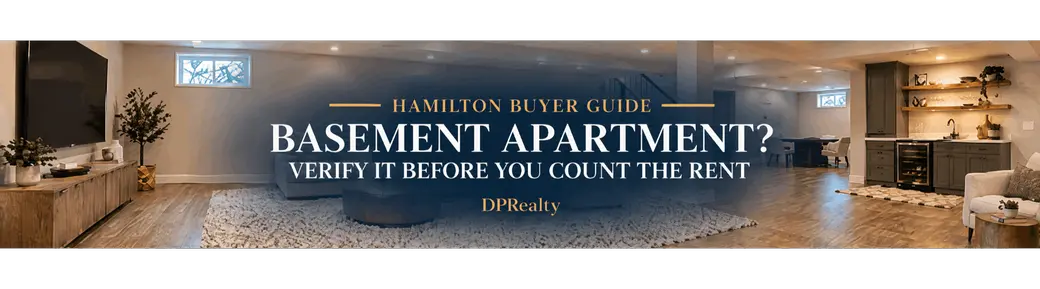
Buying a Hamilton Home With a Basement Apartment? Verify These 8 Things First
A separate entrance, second kitchen or advertised rent can make a Hamilton home look easier to afford. None of those things, by themselves, tell you what the basement unit is, what records support it or whether your lender will count the income the way you expect.
If the basement apartment affects what you are willing to pay or whether the mortgage works, verify the assumptions before you count the rent.
Information reviewed against current City of Hamilton and Tribunals Ontario guidance on October 6, 2026.
A basement apartment is not one yes-or-no question
Buyers sometimes ask whether a basement apartment is “legal.” The better approach is to break that question into the pieces that actually affect the purchase.
Hamilton has property-specific zoning, building and occupancy records, municipal addressing requirements and a rental-housing licensing program in designated parts of the city. A tenanted property also brings Ontario tenancy rules into the transaction.
Then there are two questions the City does not answer for you: how much rent your lender will recognize and whether your insurer will cover the property as you intend to use it.
The question is not “Does this look like a basement apartment?” It is “What can we verify about this unit before its income becomes part of my buying plan?”
Start with what the listing actually claims
Hamilton listings use terms such as basement apartment, in-law suite, secondary suite, Additional Dwelling Unit, separate entrance, second kitchen, income potential and duplex.
Those descriptions are not interchangeable.
A second kitchen does not establish that the basement is an authorized separate dwelling unit. A separate entrance does not prove permit status. “Rental potential” does not establish what the City recognizes or what a lender will count.
Treat the listing description as the starting point, then compare it with the available property evidence.
Check what is permitted at that specific Hamilton address
Hamilton refers to a separate self-contained residential unit on the same property as the principal dwelling as an Additional Dwelling Unit, or ADU. Zoning documents may also use the term Secondary Dwelling Unit.
The City's current guidance directs property owners to check the specific address against Hamilton's zoning mapping and the applicable zoning by-law. Some zones can support multiple dwelling units, but that does not mean every existing basement configuration automatically complies with every applicable requirement.
The useful question: What does the current zoning permit at this property, and does the basement you are looking at match that use?
Find out what documentation actually exists
Hamilton's Building Division may hold records such as building permits, surveys, site plans, building plans, grading documents and occupancy permits.
That does not mean every old Hamilton house will have a perfect digital paper trail. The City specifically warns that requested documents are not guaranteed to be available and that older records can be less comprehensive than modern submissions.
There is also a practical buyer issue: regular property-record requests involving plans generally require proof of ownership or permission from the current owner. During a purchase, that may mean asking the seller to provide the records, authorize access or address the documentation through the agreed due-diligence process.
No record found does not automatically mean “illegal.” But a finished basement and confident MLS description do not prove the required approvals either. Missing information becomes part of the buying decision.
Check whether the unit matches Hamilton's official addressing
Hamilton regulates municipal numbers and unit numbers for multi-unit properties and ADUs. The City's assigned municipal address is the official address, regardless of numbers used informally elsewhere.
For an existing basement suite, I would ask:
- Is there a City-assigned unit number or municipal address for the unit?
- Does the physical unit match the addressing information?
- Is the unit number displayed as required?
- Does the documentation describe the same configuration you are viewing?
An official address does not prove every zoning, building, fire or licensing issue. It is another useful piece of the evidence trail.
Check whether Hamilton's rental-housing licence applies
Hamilton's Rental Housing Licensing program is now permanent and currently operates in Wards 1, 8 and parts of Ward 14.
The program applies to qualifying rental housing in those current areas, including certain buildings or parts of buildings with five or fewer self-contained units, detached homes and townhouses. Exemptions exist, so the address and property type still need to be checked.
Where the program applies, the City's current process goes well beyond simply paying for a business licence. It includes zoning verification and supporting documentation, as well as electrical, Property Standards and Fire Safety review.
For a buyer: determine whether the property falls inside the current licensing area and, if it does, what the present licence status is. Do not assume either answer from the MLS description.
If the basement is rented, you are buying a tenancy too
An occupied basement apartment is not just an income feature. Ontario tenancy rules can affect possession, timing and what the seller can actually promise.
Current Landlord and Tenant Board guidance permits purchaser-own-use N12 notices only in qualifying circumstances. For a residential complex, that purchaser-use route generally requires an Agreement of Purchase and Sale, no more than three residential units and a genuine residential need by the purchaser or specified family member.
Current N12 instructions require at least 60 days' notice, with the termination date also subject to the rental period or fixed term. The September 21, 2026 change that can remove compensation when a landlord gives at least 120 days' notice applies to landlord-own-use, not purchaser-own-use.
That is why I would never treat “vacant possession available” as a casual listing promise when the unit is actually tenanted.
If your purchase depends on a tenant leaving, involve the real-estate lawyer early and make sure the Agreement of Purchase and Sale reflects what can lawfully and realistically be delivered.
Confirm how much basement rent your lender will actually recognize
A buyer may see a projected $1,800 monthly rent and immediately subtract that amount from the cost of owning the house.
That is not how I would build the purchase decision.
Lenders can treat rental income differently depending on the borrower, mortgage product, property type, documentation, occupancy, number of units and underwriting rules.
The number that matters is not the listing agent's rent estimate. It is the amount your lender is actually prepared to recognize in your mortgage qualification.
If the mortgage only works when the basement rent is counted a particular way, get that answer before removing your financing protection.
Tell the insurer how the property is actually being used
A home containing a rental unit can raise different insurance questions from an owner-occupied single-family property.
The insurer may need accurate information about the number of units, occupancy, kitchens, entrances, electrical and heating systems, renovation history and other property characteristics.
Do not wait until closing week to discover that the insurer needs more information about the basement.
The insurance professional determines the coverage. My role is to make sure the question is identified before it turns into a closing problem.
What if the basement looks professionally finished?
That tells you something about condition.
It does not tell you what permits were issued, what use the City recognizes, whether the unit is licensed where required or how your lender and insurer will treat it.
The opposite can also be true. An older basement apartment may have a long legitimate history while surviving municipal records are limited.
Do not make either conclusion from appearance alone.
What if the listing says the basement apartment is “legal”?
Ask what supports the statement.
Depending on the property, useful evidence may include:
- current zoning information;
- building permits and approved plans;
- occupancy information;
- inspection history;
- municipal addressing;
- rental-licence information where applicable;
- existing lease and tenancy documents; and
- legal advice where the status remains unclear.
The goal is not to prove that somebody used the wrong word in the listing. The goal is to understand what you can reasonably rely on before the basement affects your offer price or financing.
Should you pay more because a Hamilton home has a basement apartment?
Not automatically.
A functional income-producing unit can add utility for the right buyer. But the value of that feature depends on what can actually be supported.
Documentation
Zoning, permits, records, addressing and licence status where applicable.
Income
Actual rent or a supportable rent assumption, not simply the highest number in the listing.
Usability
Condition, parking, privacy, sound transfer, utilities, layout and ongoing maintenance.
Transaction reality
Tenancy, financing, insurance and comparable sales of properties with genuinely similar utility.
A basement that only works financially under optimistic assumptions is not the same thing as a documented, functional income-producing unit.
Before you count the basement rent, answer these questions
What does the current zoning permit at this address?
What permits, plans and occupancy records are actually available?
Does the physical basement match the documentation?
Is there an official municipal unit number or address?
Does Hamilton's rental-housing licensing program apply to this property?
Is there an existing tenant, lease or other possession issue?
How much rental income will my lender actually recognize?
Will my insurer cover the property and intended use?
Does the purchase still make sense if the rent is lower, delayed or unavailable?
That last question matters most. The safer purchase is not necessarily the one with the largest projected rent. It is the one that still makes sense after the important assumptions are tested.
Keep the basement suite in the context of the whole purchase
If the rental income is part of your affordability plan, it should be reviewed alongside the rest of the purchase rather than treated as a separate bonus.
Hamilton basement apartment FAQ
What makes a basement apartment legal in Hamilton?
There is no single visual feature or MLS label that answers that question. Property-specific zoning, building and occupancy records, the physical configuration, municipal addressing and licensing requirements where applicable may all be relevant. A lawyer or appropriate City department should address unresolved legal or regulatory questions.
Does every Hamilton basement rental need a rental licence?
No. Hamilton's current permanent Rental Housing Licensing program applies within designated areas, currently Wards 1, 8 and parts of Ward 14, and contains exemptions. Check the specific property rather than assuming the rule applies city-wide.
Can I request the building permits before I own the house?
Hamilton's regular property-record process generally requires proof of ownership or authorization from the owner to access plans. During a purchase, the seller may be asked to provide records or authorize access. Other municipal records processes may apply depending on the information being requested.
Can a buyer require a tenant to leave?
Not automatically. Ontario purchaser-own-use rules apply only in qualifying circumstances and involve specific notice, timing, compensation and good-faith requirements. If vacant possession matters to the purchase, involve the lawyer before relying on it.
Should I pay more for a house because the basement produces rent?
Only after considering the quality of the unit, documentation, tenancy, realistic rent, lender treatment, insurance, operating responsibilities and comparable sales. Projected income by itself does not establish the feature's market value.
This guide was reviewed against current City of Hamilton and Tribunals Ontario information available October 6, 2026.
- City of Hamilton, Additional Dwelling Units
- City of Hamilton, Property Record Search
- City of Hamilton, Municipal Addressing
- City of Hamilton, Rental Housing Licence
- Tribunals Ontario, current N12 instructions
- Tribunals Ontario, September 21, 2026 legislative update
Do the due diligence before you count the rent.
Send me the address and tell me how important the basement income is to your plan. I can help organize the property and transaction questions, compare the home with the alternatives and identify what needs to be confirmed with the City, lender, insurer or lawyer before you rely on the suite.
This article provides general real-estate information for Hamilton buyers. It is not legal, zoning, building-code, fire-code, mortgage, insurance, appraisal or tax advice. The status and permitted use of an existing unit depend on the specific property, current municipal requirements, available records and applicable law. Tenancy rights and termination procedures are fact-specific. Confirm material issues with the City of Hamilton and the appropriate qualified professionals before relying on an existing suite or rental income in a purchase decision.
Categories
Recent Posts




PLAN YOUR NEXT MOVE