
Hamilton’s $572 Million Housing Deal: What the Development Charge Plan Means for Buyers
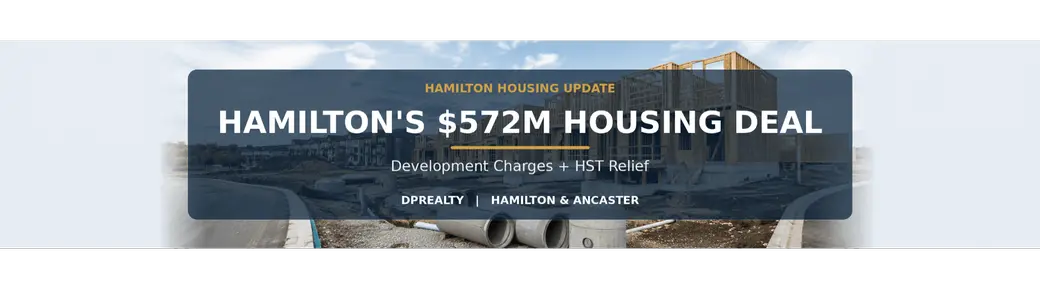
Hamilton just announced $572 million in federal and provincial funding for roads, water and wastewater infrastructure, tied to a three-year elimination of residential development charges. The headline getting most of the attention is that the change could reduce the cost of building some new homes by as much as $100,442, while helping unlock more than 31,000 homes across Hamilton.
This is a big deal if you're looking at new construction in Hamilton or Ancaster, but it's easy to get ahead of things if you stop at the headline. As it stands, the charges have not been eliminated and builders are still paying under the current system until Hamilton and Ontario execute their funding agreement. The $100,442 number is not a guaranteed rebate available to every future buyer.
So if you're comparing a new build with a resale home, it's a bad idea to assume that you can take the purchase price and subtract $100,442. What this really means for buyers depends on the project, the builder's pricing, the purchase agreement, HST treatment, closing adjustments and how the final development-charge program is implemented.
If you're looking at a Hamilton or Ancaster new build, I can help you compare the real estate side against your resale alternatives and identify the questions that should go to your lawyer, lender or tax professional.
Compare Your OptionsWhat did Hamilton actually announce?
Hamilton received approval for $572,040,664 through the federal-provincial Development Charge Reduction Program. The money is intended for roads, water and wastewater infrastructure needed to support more housing while Hamilton commits to eliminating residential development charges for three years.
The federal announcement identifies the intended development-charge period as March 30, 2026 through March 31, 2029. Hamilton's own update adds an important detail: the City and Province still need to execute a Transfer Payment Agreement before the final process is in place.
Until that happens, builders and developers continue paying development charges under the current system. Hamilton says it expects to create a refund process for eligible residential developments afterward, retroactive to March 30, 2026 and based on the final agreement.
Read Hamilton's Development Charge Reduction Program update →
What is a development charge?
Development charges are one-time municipal fees generally collected from developers when building permits are issued. They help pay for infrastructure and services needed as a city grows, including roads, water and sewer systems, transit, fire and police services.
They're part of the cost of building new housing, but they aren't the same thing as land transfer tax, property tax, HST, legal fees, mortgage costs or the various adjustments that may appear in a builder's purchase agreement.
And if you're buying a resale home, this announcement does not create a development-charge rebate for you at closing.
Does every new-home buyer save $100,442?
No.
The government is describing savings of up to $100,442 in reduced building costs. That's very different from saying every buyer gets a cheque for $100,442 or every builder immediately cuts the price of every home by that amount.
What the number does mean
Reducing development charges can lower the cost structure behind eligible new construction. That can improve project economics and create room for lower buyer costs.
What it does not mean
It does not prove that every builder will reduce every advertised price by the maximum amount or that an existing purchaser will personally receive a refund.
The actual benefit could vary substantially depending on the housing type, project, development-charge rate, permit timing, builder pricing and the final terms of the government agreement.
A builder may pass through some or all of the savings. They may also change incentives, upgrades or pricing elsewhere. That's why I'd pay a lot more attention to the actual price sheet and purchase agreement than to a headline number.
How does this line up with the current HST rebates?
This is where the timing gets especially interesting.
The federal and Ontario governments have also introduced substantial HST relief for qualifying new-home purchases. The federal Hamilton announcement says development-charge savings could combine with as much as $130,000 in new-home HST relief.
That creates a potentially meaningful affordability window for some new-construction buyers, but these programs should not be lumped together into one giant discount.
The Canada Revenue Agency says Ontario's temporary Enhanced New Housing Rebate generally applies to qualifying builder agreements entered into between April 1, 2026 and March 31, 2027, subject to additional requirements. First-time buyers may also qualify for separate federal GST/HST relief on eligible new homes.
If you qualify for these programs and the builder's pricing also reflects development-charge savings, the combined effect could be substantial. But this is exactly where I would want to see the actual agreement before assuming anything.
Ontario Enhanced New Housing Rebate
Separate eligibility rules apply, including agreement timing and other requirements.
CRA guidance →First-Time Home Buyers' GST/HST Rebate
A separate federal program for qualifying first-time buyers of eligible new homes.
CRA guidance →Hamilton already had development-charge reductions
This isn't Hamilton's first move to reduce development charges.
Council previously approved a temporary 20% development-charge exemption beginning September 1, 2025. The City later approved another temporary 4% reduction intended to offset a scheduled inflation increase from June 1, 2026 through May 31, 2027.
The new announcement goes much further by proposing a full residential elimination for three years. The final agreement still needs to explain how that interacts with the reductions already in place.
Which Hamilton infrastructure projects received funding?
Hamilton submitted five infrastructure packages and four received funding approval.
Barton Street + Lewis Road
Barton Street between Fruitland Road and Fifty Road is planned for widening and reconstruction. Lewis Road between Highway 8 and Barton Street is planned for reconstruction and urbanization.
Rymal Road + Garner Road
The package includes work on Hamilton Mountain and major Garner Road work in Ancaster between Wilson Street and Glancaster Road.
Greenhill Water Pumping Station
Hamilton says the upgrades are intended to increase water capacity and support additional housing growth.
Woodward water + wastewater
The Woodward work is intended to expand long-term servicing capacity for future communities.
Hamilton's Queenston Road Diversion Sewer application was the one submission that did not receive funding approval through this decision.
Does this mean 31,000 new homes are approved?
No.
Hamilton estimates that the infrastructure work and development-cost relief could help unlock more than 31,000 homes. That's a measure of potential capacity, not 31,000 approved homes ready to hit the market.
Those projects still have to work through planning, servicing, financing, permits and construction.
It's still a meaningful number because it shows the scale of housing growth the City and other levels of government are trying to support. I just wouldn't treat it as current inventory.
What does the announcement mean for different buyers?
New-construction buyers
This is where the announcement is most directly relevant. The actual benefit still has to be traced through the project, price sheet and purchase agreement.
Buyers already under contract
Don't assume you're receiving a refund. Your agreement will matter, particularly any wording dealing with development charges, incentives, credits or adjustments.
Resale buyers
There is no direct development-charge rebate on the purchase of an existing home. More future supply could matter over time, but that isn't a current resale discount.
Existing homeowners
The infrastructure projects may be more directly relevant than the development-charge program, especially near the affected roads and servicing projects.
What I would check before buying a Hamilton new build
Get the full price sheet. Find out what's included, what's optional and whether current incentives are already reflected in the advertised price.
Ask whether the price reflects existing Hamilton reductions, the proposed full elimination, an expected future refund or no adjustment at all.
Your lawyer should identify which builder charges are fixed, capped, estimated or potentially open-ended.
If the builder later receives a municipal refund, determine whether your agreement requires any amount to be credited back to you.
Confirm whether HST is included, which rebate the price assumes and what happens if you later turn out not to qualify.
Review utility connections, meters, grading, landscaping, common expenses, occupancy fees, warranty costs and other builder adjustments.
Make sure the required addendum matches the property type and the date the agreement is entered into.
A builder's agreement is drafted by the builder's lawyer. Have your own real estate lawyer review it while you still have an opportunity to act on the advice.
Compare total price, upgrades, closing costs, lot, parking, timing, financing, neighbourhood and current resale evidence before deciding which option is actually better.
Hamilton First-Time Home Buyer Guide →
Hamilton First-Time Buyer Programs →
This could make some Hamilton new builds much more interesting
Hamilton getting $572 million for housing infrastructure is a big deal. If the full development-charge elimination is implemented the way it's currently being described, it should make some projects easier to build and could materially reduce the cost structure behind new housing.
Combined with the current HST programs, there could be a very real window where qualifying buyers see significantly better economics on new construction than they would have seen a year or two ago.
But I still wouldn't buy a new build because the government announced a six-figure savings number.
I'd want to know exactly what the builder is charging, what incentives are already included, what happens to any future development-charge refund, what HST assumptions are built into the agreement and how the final cost compares with a resale alternative.
Hamilton real estate guidance →
Current Hamilton market data →
Hamilton development-charge FAQ
Where the information comes from
Send me the project, price sheet and the resale property you're considering. I'll help you compare the real estate side so you can see where the actual value and trade-offs are.
Talk With Derek About Your OptionsThis article provides general Ontario real-estate and municipal-policy information and includes my interpretation of what the current announcements could mean for buyers. It is not legal, tax, accounting, mortgage, appraisal, engineering, municipal-planning or investment advice. Development-charge rules, government agreements, refund processes, builder prices, HST programs and purchase-agreement terms can change. Confirm current information with the applicable authority and obtain appropriate professional advice before entering into or changing a purchase agreement.
Categories
Recent Posts








PLAN YOUR NEXT MOVE